What's the real build volume, and is it big enough for typical projects?
ELEGOO lists the Neptune 3 Pro's build volume at 225 x 225 x 280 mm, or 8.85 x 8.85 x 11 inches. That's enough room for cosplay props broken into panels, standard prototyping parts, and most single-object hobbyist prints, though it won't accommodate large single-piece items without splitting them in slicer software first. Measure your tallest planned print against the 280 mm ceiling before assuming it'll fit.
Does the auto bed leveling actually work as advertised?
The printer uses 36-point automatic bed leveling to build a height-compensation mesh before each print, catching an imperfect bed without manual corner-adjusting. Buyers are mixed on it, though, and on bed adhesion too, which sets both apart from the strongly positive feedback on quality, print quality and speed. That gap suggests the leveling system doesn't clear every buyer's bar consistently, so don't treat 'auto' as 'maintenance-free': clean the probe periodically and recheck calibration after moving the printer.
How loud is the Neptune 3 Pro during a print?
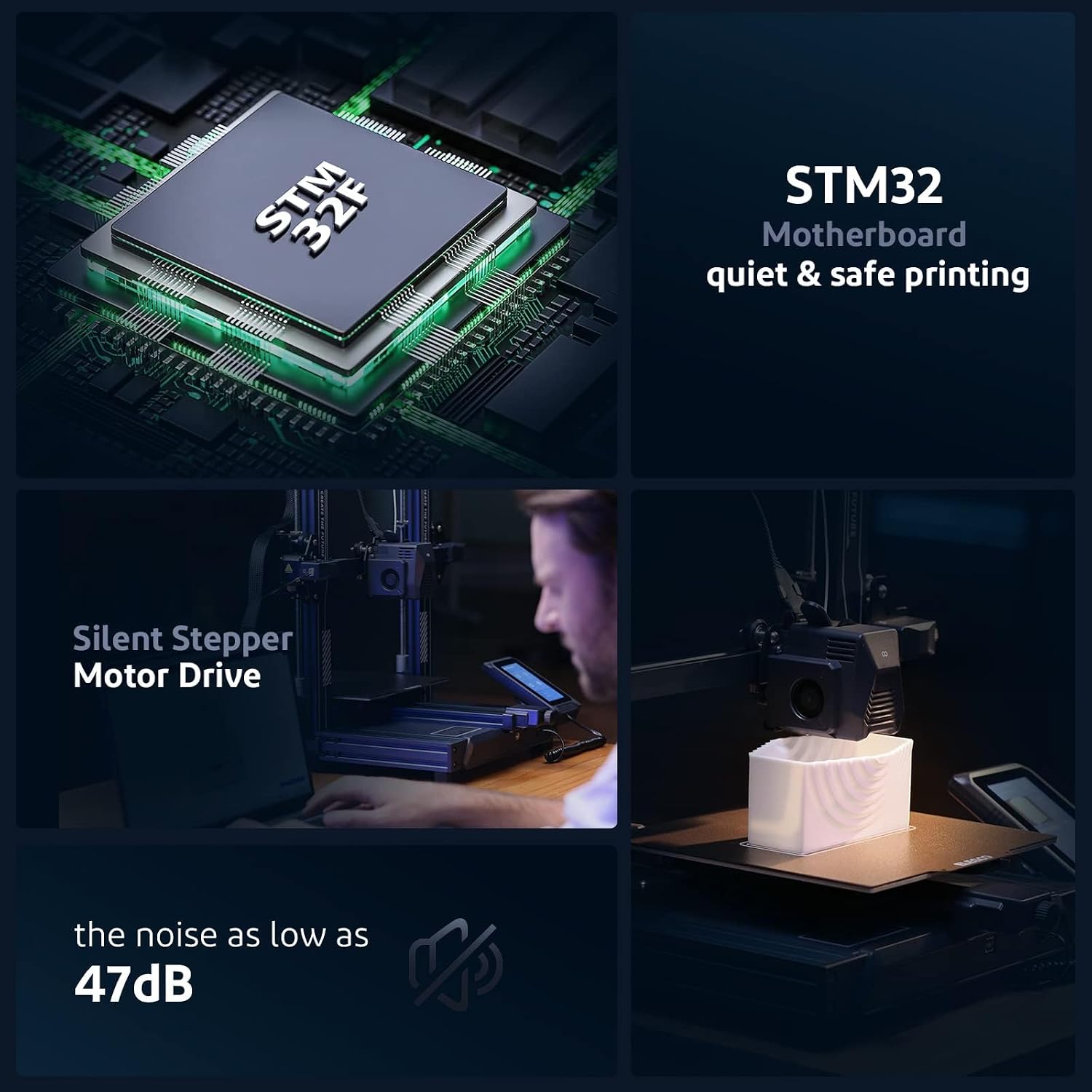
ELEGOO pairs silent stepper motors with an STM32 motherboard and quotes noise levels as low as 47dB, but buyers are mixed on noise, so it's not a uniformly quiet machine in practice. Cooling fans and vibration at speed are the usual culprits on printers in this class. If you're planning to run it in a bedroom or shared space overnight, think about where you'll physically place it before your first long print job.
Will the nozzle setup actually reduce clogs?
The hot end pairs a titanium throat tube with a brass nozzle and a widened aluminum heat sink, cooled by a front-mounted fan. Titanium's low heat conductivity keeps the break zone cooler than cheaper steel or aluminum throat tubes, which is the usual fix for heat-creep clogs, and the wider heat sink gives the cooling fan more surface area to pull heat off quickly. It's a sound design for the PLA, PETG, TPU and ABS that ELEGOO rates it for; for high-temp filaments like nylon, check with ELEGOO before assuming the stock hot end can cope.
Is this actually a good printer for a first-time buyer?
Buyers rate it well on exactly the things a beginner cares about: quality, print quality, speed and beginner-friendliness are all clear positives, and it is widely seen as a great starter machine that is easy to set up. The main parts arrive pre-assembled with a full toolkit, and a filament runout sensor and power-loss resume take some of the worry out of long prints. That said, a meaningful minority of owners are unhappy, and adhesion, auto-leveling, noise and durability all draw mixed feedback, so go in expecting some setup troubleshooting rather than a flawless out-of-box experience.
Is the direct drive extruder genuinely metal-geared?
Yes. The extruder is a dual-gear direct drive unit with a 3:1 gear ratio and SUS303 stainless steel gears, not the plastic-geared direct drives sometimes found on printers at this level, and ELEGOO says it gives consistent feeding and fewer clogs. The printer itself weighs 22 pounds with an aluminum build, worth factoring in if you plan to move it between rooms or a workshop regularly.